Why does the right artist bench matter so much for hours at a grand piano?
The bench is the only part of the piano you actually sit on, and the wrong one undermines technique, comfort, and posture. Here is what an adjustable artist bench should offer.
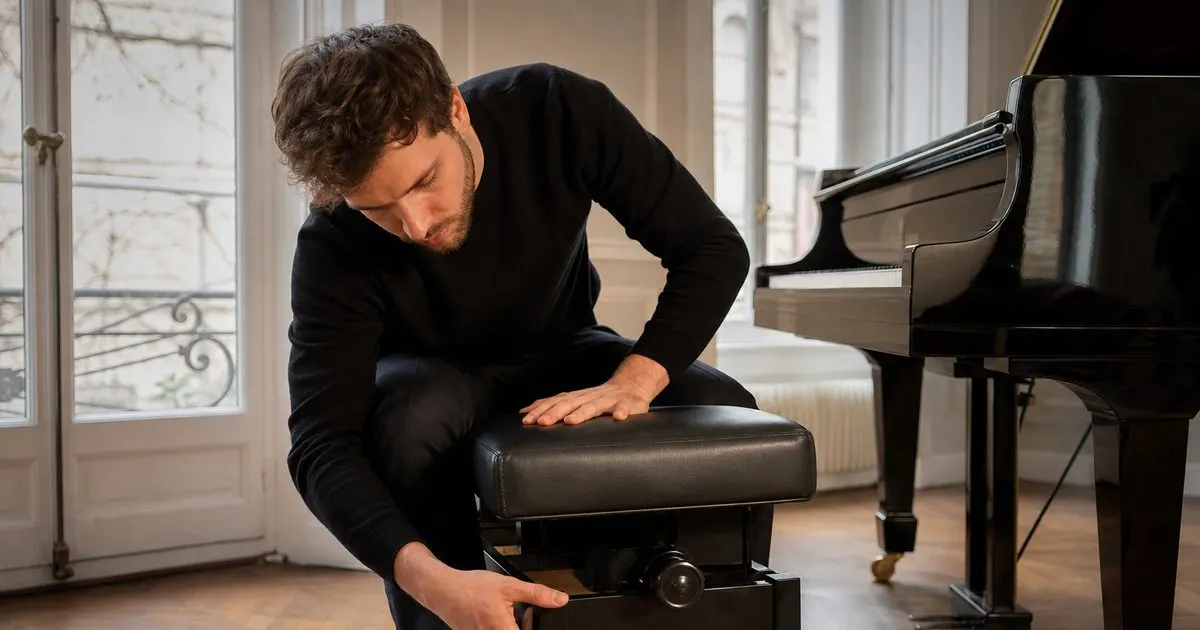
Height is technique, not comfort
The height of the seat determines the angle of the forearm to the keyboard, and that angle governs how weight is delivered into the key. Too low, and the wrist rises, the fingers reach, and tension builds in the forearm and shoulder. Too high, and the player leans over the keys, the wrist drops, and control of soft playing suffers. A fixed-height bench forces every pianist in a household, from a child to a tall adult, into a compromise. Related: Which room conditions best preserve a fine high-end piano over many decades?
An adjustable artist bench with a fine-threaded mechanism lets each player set the height precisely and repeat it every time. The right height for most pianists puts the elbow level with or slightly above the key surface when the shoulders are relaxed. Teachers use this setting as a diagnostic tool; a student whose sound changes when the bench is raised an inch has learned something about weight and release that words alone could not teach.
Keep reading: How do you choose between a grand and upright piano for the home?, What makes a concert grand piano worth its considerable investment for discerning musicians?, Which room conditions best preserve a fine high-end piano over many decades?. See how Pianoluxe helps you a pianist guide to buying grand and upright pianos.
What separates an artist bench from a furniture bench
A furniture-grade bench matches the piano's finish and often opens for music storage, but the seat is usually fixed, the frame is lightly built, and the padding is thin. An artist bench is built as a piece of equipment. The frame is heavy hardwood or steel, the adjustment mechanism is a pair of threaded rods or a rack that moves smoothly under load, and the top is thickly padded and covered in leather or a durable fabric that does not creak or slide. Related: Are hand-built pianos meaningfully better than factory produced instruments for serious players?
The difference shows over hours. A cheap bench flexes and squeaks, the seat compresses unevenly, and the player shifts to compensate without noticing. A good artist bench stays silent and level, so the only variable in a practice session is the music. Many concert pianists travel with their own bench for exactly this reason, and the designs that survive that life are the ones worth buying for home. Related: What makes a concert grand piano worth its considerable investment for discerning musicians?
Seat depth, width, and the question of a backrest
Seat depth matters more than most buyers expect. A deep seat encourages sitting back and reaching, while a shallower seat, typically supporting half or a little more of the thigh, lets the pianist sit toward the front edge with the feet free to work the pedals. Width is a matter of use: a single bench allows freedom of lateral movement, while a duet bench is essential for four-hand playing and for lessons where the teacher sits beside the student.
Backrests are a genuine option for pianists with back concerns or for long teaching days, and several makers offer benches with a low, adjustable support. Most pianists find that a backrest interferes with the forward lean needed for big fortissimo passages and choose to do without, but for someone who spends many hours at the instrument daily, the choice is worth trying rather than dismissing on principle.
Matching the bench to the piano and the home
A fine grand deserves a bench that looks as though it belongs. Most artist benches come in a polished or satin black that suits an ebony case, and some makers will finish them to match walnut or mahogany. Leather tops wear elegantly and are easy to clean, while fabric is quieter under a shifting pianist and cooler in warm rooms. Whichever you choose, rubber or felt feet protect wood floors and keep the bench from creeping during vigorous playing. Related: How do you choose between a grand and upright piano for the home?
If you buy through a piano dealer, the bench is often negotiable as part of the purchase, and a dealer who wants the sale will usually offer a proper artist bench rather than the standard furniture piece. As an independent guide we may earn a commission on some bench recommendations, so we will always say so, and we will always tell you when the bench that came with the piano is already good enough.
- Seat height sets the forearm angle and therefore how weight reaches the keys; it is technique, not comfort.
- An artist bench has a heavy frame, a smooth threaded adjustment, and a thick, silent top.
- Choose a shallower seat that lets you sit forward, and a duet width only if you teach or play four-hand music.
- Negotiate the bench with the piano purchase, and ask for an artist bench rather than a furniture bench.

Julien Jimenez
Julien Jimenez is an independent software builder based in Paris. He designs, ships, and operates focused SaaS products for small businesses and independent professionals. Read the full author page.
An Instrument for a Lifetime
A pianist guide to buying grand and upright pianos. Pianoluxe is built to help you put this into practice.
Find your pianoMore from the Pianoluxe blog
How do you choose between a grand and upright piano for the home?
What makes a concert grand piano worth its considerable investment for discerning musicians?
Which room conditions best preserve a fine high-end piano over many decades?
Get the complete high-end grand and upright pianos guide
Our full buying guide, the price guide, and new research as we publish it. One email, no spam, unsubscribe any time.