How often should a new high-end piano be tuned during its first year at home?
New strings stretch, new pins and bridges seat, and a new room changes everything. Here is why the first year needs more tunings than any other and how to schedule them well.
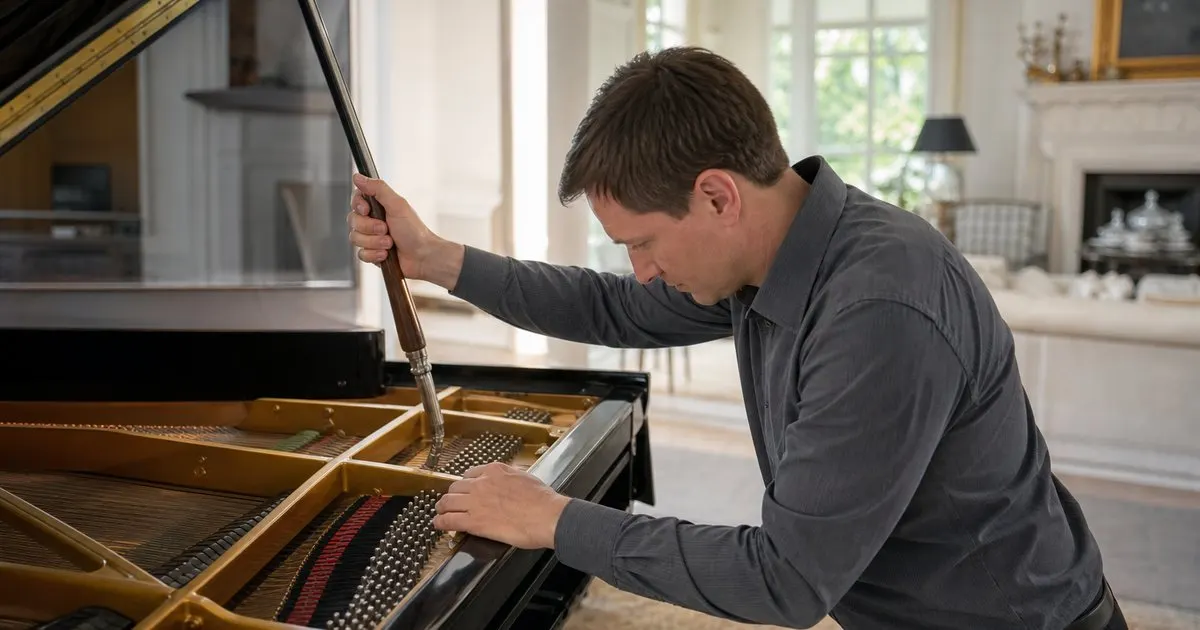
Why a new instrument drifts
A piano fresh from the factory is under tension for the first time in its life. Steel strings continue to stretch for months after they are first brought to pitch, the tuning pins, hitch pins and bridge pins seat, and the wooden structure adjusts to the tension of many tons pulling across the plate. Every one of those changes shifts the pitch slightly, and almost always in the direction of going flat. The felt in the hammers and dampers compresses over the same months, but that affects regulation and tone rather than pitch; it is the reason to have the action checked during the first year, not a reason the piano goes flat. Related: Why does soundboard material shape the tonal character of a luxury grand piano?
Add the room. A piano that spent months in a controlled factory hall and then a showroom now lives in a house with a heating cycle, a kitchen nearby, and windows that let in sun. The soundboard absorbs and releases moisture with each season, rising and falling in crown, and the strings that cross it rise and fall in pitch with it. The first year is when all of these settling processes overlap, which is why it demands more tunings. Related: Are hand-built pianos meaningfully better than factory produced instruments for serious players?
Keep reading: How do you choose between a grand and upright piano for the home?, What makes a concert grand piano worth its considerable investment for discerning musicians?, Which room conditions best preserve a fine high-end piano over many decades?. See how Pianoluxe helps you a pianist guide to buying grand and upright pianos.
A sensible schedule for year one
Most technicians and makers recommend that a new piano be tuned more frequently in its first year than it will need later, with the exact number depending on the instrument and the home. A common approach is a tuning shortly after delivery, once the piano has had a few weeks to acclimate, followed by tunings spaced through the year and timed to the change of seasons, when the biggest humidity swings occur. Your dealer may include the first one or two of these; ask before delivery. Related: How do you choose between a grand and upright piano for the home?
The goal of these early tunings is not only to correct pitch but to establish a stable pitch level. A piano that is allowed to drift well below pitch and then pulled up in one session will not hold; the tension change unsettles it again. Frequent, smaller corrections keep the instrument close to pitch so each tuning is a gentle refinement. By the second year, a well-settled piano in a stable room usually needs fewer visits.
What the technician should do beyond tuning
The first-year visits are the right time to have the technician look at regulation as the felts compress and the action settles. Key height, hammer let-off, and damper timing can all shift slightly in the first months, and a technician who is already at the piano can make small corrections cheaply. Ask for a brief written note of what was checked, so the next visit has a baseline to compare against.
This is also when to raise the subject of voicing. New hammers are often on the bright side and will mellow with playing, but if the piano sounds harsh in your room after a few months, gentle needling by a skilled technician can bring it into balance. Do not rush this; a piano voiced too early can end up dull once the felt has broken in naturally. Let the instrument tell you what it needs.
Controlling the room to reduce the work
The most effective way to reduce tuning frequency is to stabilize humidity. A whole-room humidifier and dehumidifier, or an in-piano climate control system installed by a technician, keeps the soundboard from swinging through each season and dramatically improves how long a tuning holds. Placement away from exterior doors, heating vents, fireplaces, and direct sun helps just as much and costs nothing. Related: Which room conditions best preserve a fine high-end piano over many decades?
Keep a simple log of tuning dates, the room's humidity reading, and any observations about the sound. Over a couple of years, this record shows you the instrument's own rhythm and lets you and your technician settle on a schedule that suits it. Some pianos in stable rooms need only occasional attention; others, in older houses with big seasonal swings, need more. The log tells you which you own.
- New strings stretch and pins and bridges seat, so a new piano goes flat faster in its first year than it ever will again.
- Tune soon after delivery once the piano acclimates, then time later visits to the change of seasons.
- Use first-year visits to check regulation and, if needed, gentle voicing as the hammers break in.
- Stabilizing room humidity is the single biggest factor in how long any tuning holds.

Julien Jimenez
Julien Jimenez is an independent software builder based in Paris. He designs, ships, and operates focused SaaS products for small businesses and independent professionals. Read the full author page.
An Instrument for a Lifetime
A pianist guide to buying grand and upright pianos. Pianoluxe is built to help you put this into practice.
Find your pianoMore from the Pianoluxe blog

How do you choose between a grand and upright piano for the home?

What makes a concert grand piano worth its considerable investment for discerning musicians?

Which room conditions best preserve a fine high-end piano over many decades?
Get the complete high-end grand and upright pianos guide
Our full buying guide, the price guide, and new research as we publish it. One email, no spam, unsubscribe any time.